
Every insurance agency owner seems to have the same marketing conversation at least once a year.
“We really need to start doing more with Facebook.”
Everybody agrees. Somebody gets assigned the project, usually because they’re good with Canva or post on the agency’s Facebook page occasionally, and then absolutely nothing happens.
Or the agency tries boosting a few posts, spends a couple hundred dollars, gets some likes and a handful of questionable inquiries, and decides Facebook advertising doesn’t work.
The problem usually isn’t that Facebook advertising is impossible for insurance agencies. It’s that nobody at the agency has been given the time, direction, or resources to learn how to do it properly.
I’d make changing that one of your agency’s goals for 2027.
You don’t necessarily need a full-time marketing employee. You don’t have to hire an outside advertising agency. And you certainly don’t need to become an expert in every advertising platform.
But I think every insurance agency that wants to generate business through digital advertising should have at least one person who understands how to build a basic campaign, handle incoming leads, and evaluate whether the advertising is producing business.
Here’s how I’d approach it.
1. Stop Treating Facebook Advertising Like a Side Project Nobody Owns
The first thing you need isn’t an advertising budget.
It’s a person.
Somebody at your agency has to be responsible for the advertising process. That doesn’t mean they have to do every task personally, but they need to know who’s doing what and whether it’s getting done.
For smaller agencies, that might be the owner. It might be a producer who wants to generate more business. It might be a CSR who has an interest in marketing.
I don’t particularly care who it is, as long as they have the time and authority to do the work.
What I wouldn’t do is casually add “handle our Facebook marketing” to somebody’s already full workload and expect great results.
Give that person a specific responsibility.
For example:
“Your goal for January is to build and launch one Facebook advertising campaign for our agency. You’ll have a test budget, time to learn the platform, and access to the resources you need. We’ll review the results together.”
That’s a real assignment.
“Post more stuff on Facebook” is not.
And even if you outsource your advertising to a marketing company, somebody inside the agency should still understand what the vendor is doing.
You should know what you’re advertising, how leads are handled, what you’re paying for, and whether those inquiries are turning into actual customers.
You don’t have to perform every marketing task to understand how your agency’s marketing works.
2. Pick a Reason Someone Would Actually Think About Insurance
One of the biggest problems I see with insurance agency advertising is how generic it is.
“Call us for a free quote.”
“We offer great rates and service.”
“Let us protect what matters most.”
There’s nothing necessarily wrong with those statements, but they don’t give somebody much of a reason to stop scrolling.
Most people aren’t wandering around Facebook hoping an insurance agency will interrupt their afternoon.
They’re looking at vacation pictures, arguing about something in a local group, or watching videos they probably shouldn’t be watching at work.
Your advertising needs to connect with something happening in their lives.
For insurance agencies, that means thinking about the situations that make people reconsider their coverage.
Here are five examples.
Homeowners Renewal Increases
A homeowner receives a renewal notice and discovers that their premium has increased.
Now they have a reason to review their coverage and consider whether other options are available.
An advertisement about understanding homeowners renewal changes is more relevant to that person than another generic message about your agency’s customer service.
Adding a Teenage Driver
A family has a teenager approaching driving age.
Suddenly, they have questions about adding a driver, vehicle coverage, deductibles, and what the changes might mean for their insurance costs.
That’s a natural opportunity for an insurance conversation.
Buying a Home
Someone preparing to close on a home needs insurance in place.
They may be unfamiliar with replacement cost, deductibles, coverage choices, lender requirements, or how to compare available options.
An agency that can help answer those questions has a reason to introduce itself.
A Contractor Taking on Bigger Jobs
A contractor starts winning larger projects and encounters insurance requirements they haven’t dealt with before.
Maybe they’re being asked for certificates, additional insured status, or coverage limits that differ from what they’ve previously carried.
Those situations create opportunities for commercial insurance conversations.
Buying or Replacing a Vehicle
Someone buying a vehicle needs to think about how that purchase affects their existing auto insurance.
They’re dealing with financing requirements, coverage choices, deductibles, and making sure everything is in place before driving away.
Again, there’s a specific reason to pay attention.
The point is to advertise around an actual insurance-related situation, rather than simply reminding people that your agency exists.
Before you build your first campaign, choose one situation that matches the business your agency can write and wants more of.
You don’t need five campaigns running simultaneously.
You need one relevant campaign that your agency is ready to handle.
3. Build the Entire Lead Process Before You Run the Ad
Here’s something that doesn’t get enough attention when people talk about Facebook advertising.
Getting somebody to fill out a lead form is only the beginning.
Before you run an advertisement, you should be able to answer these questions:
- Where does the Facebook lead go?
- Who receives the notification?
- How quickly can somebody respond?
- What information does the agency need to prepare a quote?
- Where does the prospect provide that information?
- What happens when somebody doesn’t complete the process?
- How will you know whether the inquiry became a customer?
If you can’t answer those questions, you’re probably not ready to start paying for leads.
Use a Short Facebook Lead Form
For many insurance agency campaigns, I’d start with a short Facebook instant form.
The objective is to identify somebody who wants to begin a conversation about a specific insurance need.
You don’t necessarily need to collect every detail required to quote a policy in that initial form.
For example, a teen-driver campaign might ask whether the person is preparing to add a newly licensed driver or planning ahead for a driver who will be licensed soon.
That’s useful information for starting the conversation.
But there’s no reason to make somebody complete an entire auto insurance application before they’ve even spoken with your agency.
Give Them a Specific Next Step
After submitting the form, the prospect needs to know what happens next.
This is where a lot of agencies make things unnecessarily difficult.
Their ending screen says something like, “Thanks for your interest. Visit our website.”
Visit your website and do what?
Look around? Find your contact page? Submit another generic form?
Give the prospect a specific next step.
For example:
“Thanks for requesting information about adding a teen driver. Continue to our secure auto insurance intake to provide the details our team needs to review your options.”
Then link directly to the appropriate intake experience.
The objective is to make the process understandable and convenient.
Test the Entire Process Yourself
Before your first advertisement goes live, submit a permitted test inquiry.
Find the lead. Confirm that the right employee can access it. Open the intake link on your phone. Complete a test submission using the platform’s supported testing method.
Make sure the information arrives where it should.
It’s a lot cheaper to discover that your lead process is broken before you start spending money to send people through it.
4. Learn How to Put Together a Basic Facebook Campaign
You don’t have to become a professional media buyer overnight, but whoever manages advertising for your agency should understand the basic components of a campaign.
At a minimum, they should be comfortable with the following.
Campaign Objective
Meta offers different campaign objectives depending on what you’re trying to accomplish.
For an insurance agency looking to generate inquiries, the Leads objective is often an appropriate starting point.
The objective you select affects how Meta optimizes delivery and what actions it encourages.
Follow the platform’s current setup requirements, including applicable special advertising categories and targeting restrictions. Insurance advertising should be reviewed carefully for any category or policy requirements that apply.
Audience and Geography
Your targeting should reflect the customers and geographic areas your agency can actually serve.
Start with the states or locations where your agency is authorized and able to write the advertised business.
Avoid getting carried away trying to identify the perfect audience through dozens of interests and demographic assumptions.
Keep the initial setup understandable, follow Meta’s current targeting rules, and make adjustments based on actual performance.
Advertising Copy
Your copy needs to do three things.
First, introduce a relevant situation.
Second, explain why the person might want to review their insurance.
Third, tell them what to do next.
Here’s a simple example for an auto insurance campaign:
Headline: Buying a New Vehicle?
Body:
Buying a different vehicle is a good time to review your auto insurance. Your coverage needs, deductibles, and financing requirements may have changed.
Our agency can help you review available coverage options and understand what information you’ll need.
Request an auto insurance review to get started.
It’s not complicated, but it’s specific.
Compare that to “Call us for all your insurance needs.”
Creative
You don’t need a graphic design degree to make an effective advertisement.
You need something people can understand quickly while scrolling.
Use clear typography, readable text, and a visual that supports the campaign’s message.
A simple headline about buying a new vehicle can work perfectly well without stock photos of a family smiling next to a car.
Test different visual approaches rather than assuming that the most polished-looking graphic will produce the best results.
Budget
Start with an amount your agency can afford to test.
Don’t spend money you need to make payroll, and don’t expect a small test budget to produce statistically meaningful answers about every possible creative, audience, and campaign combination.
Pick one campaign, keep the initial test manageable, and give yourself enough room to observe what happens before changing everything.
Also remember that Facebook advertising costs are just one part of the equation.
Your agency has to handle inquiries, quote the business, and convert customers.
The cheapest lead isn’t necessarily the best lead.
5. Stop Measuring Success Based Only on Lead Cost
Insurance agencies love comparing cost per lead.
One agency gets leads for $8. Another pays $25. Everybody immediately assumes the agency getting $8 leads is doing better.
Maybe. Maybe not.
Cost per lead tells you how much it costs to generate an inquiry. It doesn’t tell you whether that inquiry was useful.
You need to look further into the process.
Here’s an example using hypothetical numbers.
| Metric | Campaign A | Campaign B |
| Advertising spend | $500 | $500 |
| Facebook leads | 50 | 20 |
| Cost per lead | $10 | $25 |
| Completed intakes | 10 | 12 |
| Quotes delivered | 6 | 10 |
| Policies bound | 1 | 3 |
| Advertising cost per bound policy | $500 | $167 |
Campaign A generates leads at less than half the cost.
Campaign B generates three times as many bound policies from the same advertising spend.
Which campaign would you rather have?
That’s why I recommend tracking the process beyond the initial form submission.
At a minimum, keep track of:
Facebook leads: How many people submitted the initial inquiry?
Completed intakes: How many provided the information needed to move forward?
Quotes delivered: How many inquiries became actual quoting opportunities?
Policies bound: How many became customers?
Advertising cost per bound policy: How much advertising spend was required to generate each bound policy?
For agencies that can track it, you should also look at commission revenue, expected account value, and the time required to handle the inquiries.
Don’t confuse cheap leads with profitable advertising.
6. Give Your Marketing Person a Real 30-Day Plan
If I were putting somebody in charge of learning Facebook advertising at an insurance agency in January 2027, here’s the schedule I’d give them.
Week 1: Understand the Process
Choose the first campaign.
Decide which type of customer you’re trying to reach and confirm the agency is equipped to quote that business.
Get familiar with Meta Ads Manager, the required account permissions, the lead form setup, and the agency’s insurance intake process.
Figure out who’s responsible for receiving and following up with the inquiries.
Deliverable: A written campaign plan with the audience, offer, lead process, and assigned responsibilities.
Week 2: Build the Campaign
Write the advertising copy.
Create the graphics.
Prepare the Facebook lead form.
Connect the ending screen to the appropriate intake process.
Set up notifications and follow-up procedures.
Review the materials for agency accuracy, advertising rules, and any required approvals.
Deliverable: A complete campaign that’s ready to test.
Week 3: Test and Launch
Test the lead form and intake process.
Verify the correct people receive inquiries.
Confirm conversion tracking where supported.
Set a reasonable initial advertising budget.
Publish the campaign once everything is approved.
Avoid changing every setting after the first few clicks.
Deliverable: One live campaign with a functioning lead process.
Week 4: Review What Happened
Look at the advertising spend and inquiries.
Review how many people completed the next step.
See whether leads were contacted and quoted.
Identify problems in the advertising or follow-up process.
Document what should change before the next campaign.
Deliverable: A basic performance report and recommendations for the next test.
That’s a much more useful January marketing project than “Let’s try to post on Facebook three times a week.”
And by the end of the month, your agency has somebody who has worked through the entire advertising process instead of just watching videos about it.
That doesn’t make them an expert. It gives them practical experience and a foundation to improve.
7. Make Sure Your Agency Actually Learns Something
Here’s the part I think matters most.
The goal shouldn’t be to run one Facebook advertising campaign and declare victory.
The goal should be to develop a repeatable process inside the agency.
Somebody should know how to choose a campaign, build it, get it approved, publish it, handle inquiries, and evaluate the results.
If that knowledge lives entirely with an outside vendor, you’re dependent on the vendor.
If it lives entirely in the owner’s head, you’re dependent on the owner.
And if it’s somebody’s unofficial side project with no documentation or accountability, there’s a good chance it gets abandoned when the agency gets busy.
Give somebody ownership. Make the process repeatable. Document what you learn.
You can still hire outside help. You can still outsource pieces of the work. But your agency will be in a better position to make decisions when somebody internally understands the basics.
That should be one of your marketing priorities for 2027.
Want to Skip the Part Where You Build Everything From Scratch?
Everything I’ve covered so far is something your agency can do independently.
You can choose your own campaign situations, write the copy, make the graphics, build the forms, prepare follow-up messages, and work through the implementation.
There isn’t some magical secret to any of it.
But there’s a fairly substantial amount of work involved, especially for somebody who already has a full-time job at an insurance agency.
That’s why I put together the Insurance Agency Ad Kit.
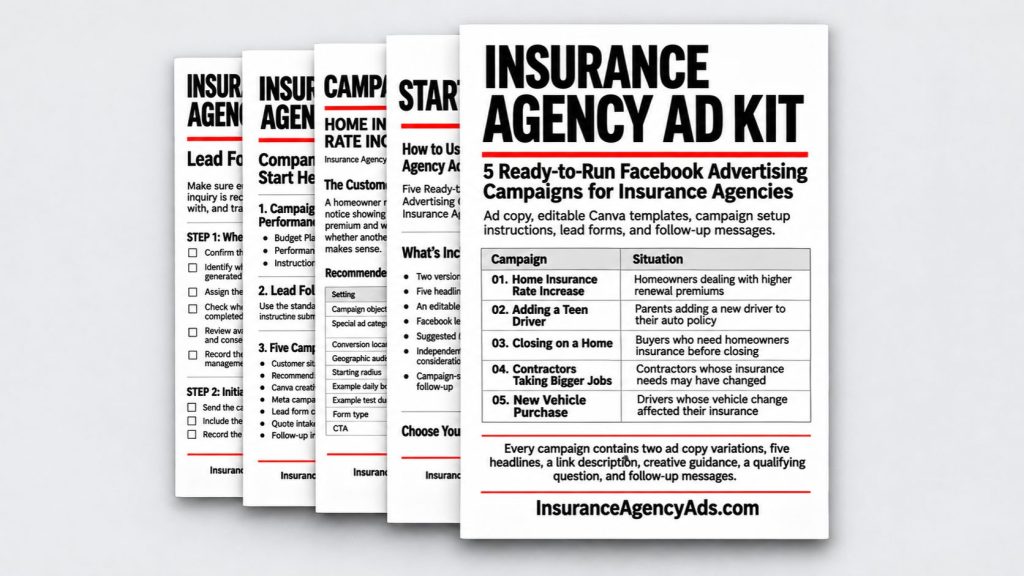
Instead of having to develop the materials for your first campaign independently, you get five ready-to-adapt Facebook advertising campaign packages.
They cover:
- Homeowners renewal increases
- Adding a teenage driver
- Purchasing a new home
- Contractors taking on bigger jobs
- Buying or replacing a vehicle
Each includes advertising copy, five headline options, editable Canva creative templates, lead form examples, ending-screen copy, and follow-up messages.
There are also setup instructions, campaign planning and performance tracking resources, a lead follow-up checklist, and three recorded getting-started walkthroughs.
Your agency still chooses the campaign, customizes the materials, completes required approvals, handles advertising spend, and manages the inquiries.
It’s not a managed advertising service, and the kit doesn’t guarantee leads or policy sales.
It’s a practical starting point for an agency that wants to run its own advertising without developing every component from scratch.
Get the Insurance Agency Ad Kit for $149. No subscriptions.
Make 2027 the Year Your Agency Actually Understands Its Advertising
You don’t need to turn your CSR into a marketing genius.
You don’t need to become obsessed with Facebook Ads Manager.
And you don’t necessarily need to bring every part of your marketing in-house.
But somebody at your agency should understand what you’re advertising, how the leads come in, what happens to them, and whether you’re generating business.
Give that person some time, a reasonable budget, and a specific project.
Start with one campaign, learn how the process works, and improve from there.
Because another year of saying “we really should do something with Facebook” isn’t going to generate much business.
You sell insurance. We’ll help with the advertising.
