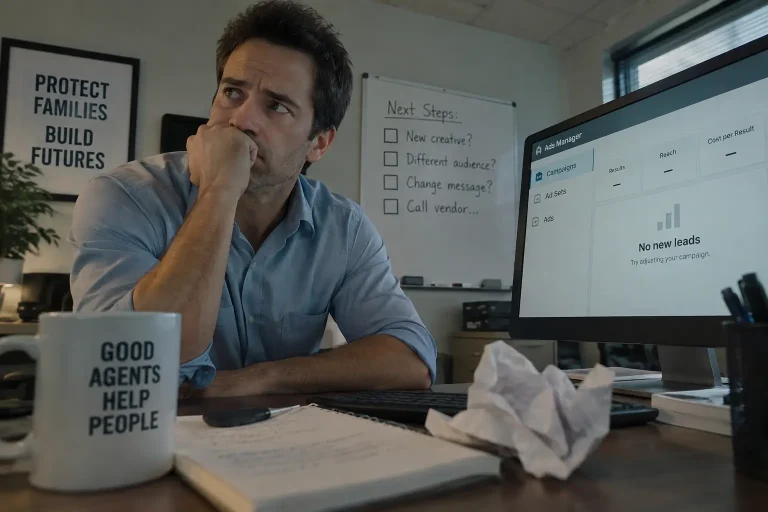
Your insurance advertising system is not the Facebook campaign you paid someone to turn on. If the leads stop tomorrow and your only move is to call the company running the ads, you do not own the system producing them.
That distinction matters more than most agents realize. You can own the agency, own the book, pay the ad bill, and still rent the process that brings the next prospect through the door.
Lead vendors made this arrangement feel normal. Send money, receive names, work the leads, repeat.
It works until you want to know why lead flow changed, why one message produced calls and another did not, or what you should change next. Then you find out how little of the process you actually control.
Your Insurance Advertising System Starts With Control
The mistake agents make is confusing access with ownership. Mike pays for the ads, gets the leads, and can log into a dashboard that shows him a few numbers. He assumes he owns the process because his credit card funds it.
Then he wants to change something.
He wants to run a homeowners ad around renewal increases instead of another generic “get a quote” campaign. He wants to see the actual copy prospects saw, understand how the form qualifies them, and know what happens after someone submits it. Suddenly, he has to ask permission, submit a request, or wait for someone else to make the change.
That is not control.
An insurance advertising system has several connected parts: the ad account, the message, the campaign settings, the lead form, the prospect data, the follow-up process, and the campaign history. You need access to those parts because each one answers a different question when something goes wrong.
I have seen agency owners blame “bad Facebook leads” when they could not even see the ad and form that produced those leads. They were trying to diagnose the last step of a process while someone else controlled everything upstream.
This matters because insurance advertising does not start with a clever ad. It starts with a specific reason somebody needs to think about insurance right now.
A homeowner opens a renewal and sees a rate increase. A contractor starts taking larger jobs. A family goes under contract on a house. Those triggers create the reason to act, and the ad has to speak directly to that situation.
When you control the system, you can trace that logic all the way through. You can see which situation the ad addresses, what promise gets the click, what the prospect sees on the form, and how your agency responds after the submission.
Without that visibility, “lead quality” becomes the explanation for everything. And once every problem gets called a lead-quality problem, you stop looking at the parts you could actually fix.
Buying Leads Gives You Leads. It Does Not Give You a System.
The mistake is treating lead generation like inventory. Buy 50 names, call them fast, quote the ones who answer, then place another order when the list runs out.
Lead vendors reinforce this because their business model depends on the transaction. When results get worse, the standard advice is predictable: work the leads harder, call faster, increase your order.
That advice skips the part an agency owner should care about most. Why did this person become a lead in the first place?
Mike can be excellent on the phone and still have no answer. He knows a name appeared in his CRM. He does not know what situation caused that person to respond, what message they saw, what question they answered, or what expectation the ad created before he called.
That missing context changes the sales conversation.
Someone responding to an ad about a homeowners renewal increase enters the conversation for a different reason than someone buying a house next month. The first person wants to know whether the increase is competitive. The second needs coverage in place before closing and may need someone to explain what the policy actually covers.
When you buy the lead, somebody else usually decides how that demand gets captured. You inherit the name at the end.
With your own insurance advertising system, you can work backward from the sales conversation. If prospects keep entering with the wrong expectation, look at the message. If the right people click but the wrong people submit, look at the form. If qualified prospects submit and nobody reaches them, the problem sits in follow-up.
“Work the leads harder” cannot tell you any of that.
The right move is to stop treating every lead problem as a sales problem. Find the exact point where the prospect went from having a reason to shop insurance to raising their hand, then make sure everything they see before the phone call sets up the conversation you actually want your producer to have.
An Insurance Advertising System Gives You Something to Diagnose
The mistake is looking at campaign performance as one number. Leads got expensive, so the ads must be bad. Leads slowed down, so Facebook must have changed something.
That diagnosis is useless because a campaign is a chain of decisions. The audience sees the creative, the first sentence identifies the situation, the body gives that situation context, the headline earns the click, and the form asks the prospect to raise their hand.
Insurance makes this especially important because the ad does not create the original demand. The trigger does. A renewal increase, a home purchase, a growing business, or another change gives someone a reason to pay attention to insurance.
I have seen agents spend too much time changing targeting when the message itself gave the right prospect no reason to stop scrolling. Meta can put an ad in front of homeowners, but “Quality Coverage You Can Count On” gives a homeowner no clue why they should care today.
That is why the copy has to do part of the targeting.
“Homeowners in Jasper County: if your home insurance premium has gone up over the last couple of years…” identifies the person, location, and trigger immediately. People outside that situation can keep scrolling. The homeowner staring at a higher renewal has a reason to read the next sentence.
Once you understand that, diagnosing an insurance advertising system gets much more useful. Start at the point where behavior changed instead of randomly changing the whole campaign.
If people see the ad and ignore it, inspect the trigger and message before touching the form. If the right people engage but submissions fall apart, inspect what you ask them to do next. If qualified prospects submit and your producers keep having confused conversations, compare the promise in the ad with the conversation your agency starts on the phone.
Changing three things at once destroys your ability to learn from any of them. Change the part tied to the problem you can actually see, then watch what happens next.
What I Actually Watch When a Campaign Is Running
The mistake is watching cost per lead like it is the campaign.
A CPL tells me what I paid for a lead. It does not tell me why the number moved, whether the right people responded, or whether the agency did anything useful with the opportunities it received.
When I look at a campaign, I want to know where the behavior changed.
Are people stopping on the ad? Are they clicking? Are they starting the form and leaving? Are they submitting information that matches the type of prospect the ad called out? What happens when that lead reaches the agency?
Those questions matter because each problem points somewhere different.
If people stop clicking an ad that previously got attention, I look at the message and creative. If people click but do not submit, I look at the transition from the ad to the form and what we ask for. If the submissions look right but producers say the conversations make no sense, I want to know whether the ad promised one conversation and the producer started another.
This is also why I do not start changing everything because a campaign has a bad stretch. Change the audience, copy, creative, form, and offer at the same time, and you have no idea which change mattered.
That habit comes straight from generic digital marketing advice. Agencies and platform gurus constantly talk about “refreshing campaigns” and testing more variables, but insurance has a specific buying trigger behind the response. If the ad speaks to homeowners whose renewal increased, replacing that message with generic insurance copy just because a dashboard moved can remove the reason the prospect paid attention in the first place.
I want the insurance advertising system to tell me where to look next.
That requires keeping enough of the campaign stable to learn from the change. One problem. One change tied to that problem. Then I can judge what the prospect actually did instead of guessing from a dashboard full of numbers.
Owning the system means you stop paying for a result you cannot explain. If you cannot see why a prospect raised their hand, diagnose what changed, and decide what happens next, you are still renting your lead flow.
If you want the system built inside your agency instead of another vendor relationship, see Insurance Agency Ads: Installed.
